
The Package Travel and Linked Travel Arrangements Regulations 2018, also known as the Package Travel Regulations (PTRs), are the consumer protection laws for the sale of holiday packages and related travel services. The PTRs ensure UK travellers are legally and financially protected when purchasing combined travel services.
If you're looking to make sense of the PTRs, you're in the right place. We've simplified the rules into bite-sized pieces to help you understand your obligations, including the amendments to the PTRs made in 2026 which will take effect in April 2027.

The UK Government's 2026 Package Travel Regulations amendments are intended to simplify the existing regulatory framework whilst maintaining strong consumer protection.
The most significant changes include:
For some travel businesses, these reforms will have little impact. For others, particularly those facilitating multiple travel services during a single booking journey, the changes may create entirely new obligations around insolvency protection and organiser liability. Businesses should therefore review their booking processes well before implementation in April 2027.
A package holiday is the combination of two or more different types of travel services as part of the same trip. There are four types of travel services:
When a single service, like a hotel stay, is combined with another tourist service, it only becomes a package if the tourist service meets one of two criteria:
A common question for hoteliers is whether access to on-site facilities, such as gyms and pools, counts as ‘another tourist service’. This is determined on a case-by-case basis:
The way holidays are sold has changed significantly, rendering the previous package holiday definition (a combination of two or more travel services) outdated. For example, dynamic packaging, where travellers put together their own holidays, is now common. The 2018 PTRs have a broad scope to cover these more modern ways to purchase package holidays.
There are currently six ways travel services combine to make a package, with a seventh coming into effect in April 2027:

The 2018 PTRs create a legal distinction between the entities involved in a travel transaction: the organiser and the retailer.
Let's define these two entities:
Travellers may be in contact with organisers or retailers when purchasing travel services.
In the simplest terms, ‘lack of conformity’ is when a travel service isn't delivered as it was promised in the contract, and it's the organiser's responsibility to fix it. Regulation 15 explains that, in some cases, it might not be possible.
However, if the organiser can't address the lack of conformity, and it substantially affects the performance of the package, the traveller is entitled to terminate the contract (without a termination fee). The traveller will also be entitled to an appropriate price reduction and, in some cases, compensation.
If the organiser doesn't remedy the problem within a reasonable time frame, the traveller may request reimbursement for the necessary expenses (unless it's impossible to address the issue). Travellers must inform the organiser without delay – failure to do so may be taken into account when calculating price reductions or compensation, where letting the organiser know would have avoided/reduced the damage.
If a package includes return travel and a failure to meet the contract terms isn't resolved, the organiser must arrange equivalent return transport. However, this obligation doesn't apply if the failure is caused by the reasons listed here:
Travellers won't be entitled to compensation for damages if the organiser proves the lack of conformity is:
Non-material damage can also be covered with compensation, including loss of trip enjoyment due to service issues.
From 6th April 2027, where an organiser or retailer has to pay compensation, give a price reduction or meet another obligation because of an event caused by a supplier, Regulation 29 confirms they have a right of redress (clarified from a “right to seek redress” to a “right to redress”) against that third party.
The amendments also require suppliers to refund organisers within 14 days of a cancellation, or of the date the service was due to be performed, whichever comes first. This is intended to make it easier for organisers to recover costs when arrangements change.
If a major part of the holiday becomes unavailable after the trip has already started, organisers have legal duties to keep the trip on track or bring the traveller home.
If a significant part of the package can't be delivered, the organiser must offer the traveller alternative arrangements. These alternatives:
The traveller also has the right to reject these alternative arrangements if they aren't comparable to what they originally booked, or if the refund they're offered for the lower-quality experience isn't fair. If they reject the alternative plans for good reason, they are entitled to a refund and potentially additional compensation.
If the organiser can't find a suitable alternative, or if the traveller validly rejects unsuitable alternative arrangements, the organiser must get them home. If it's impossible to get the traveller home in a timely fashion due to unavoidable or extraordinary circumstances, the organiser must pay the cost of the traveller's accommodation, capped at three nights per traveller.
Under regulation 18, you're required to provide appropriate assistance without delay. You're required to provide:
The organiser can charge a fee only if the difficulty was intentionally caused by the traveller or due to negligence, and the fee mustn't exceed the costs incurred by the business.
The traveller may also treat the retailers as the point of contact for messages, complaints and claims relating to their package, as the retailer sold it on behalf of the organiser.
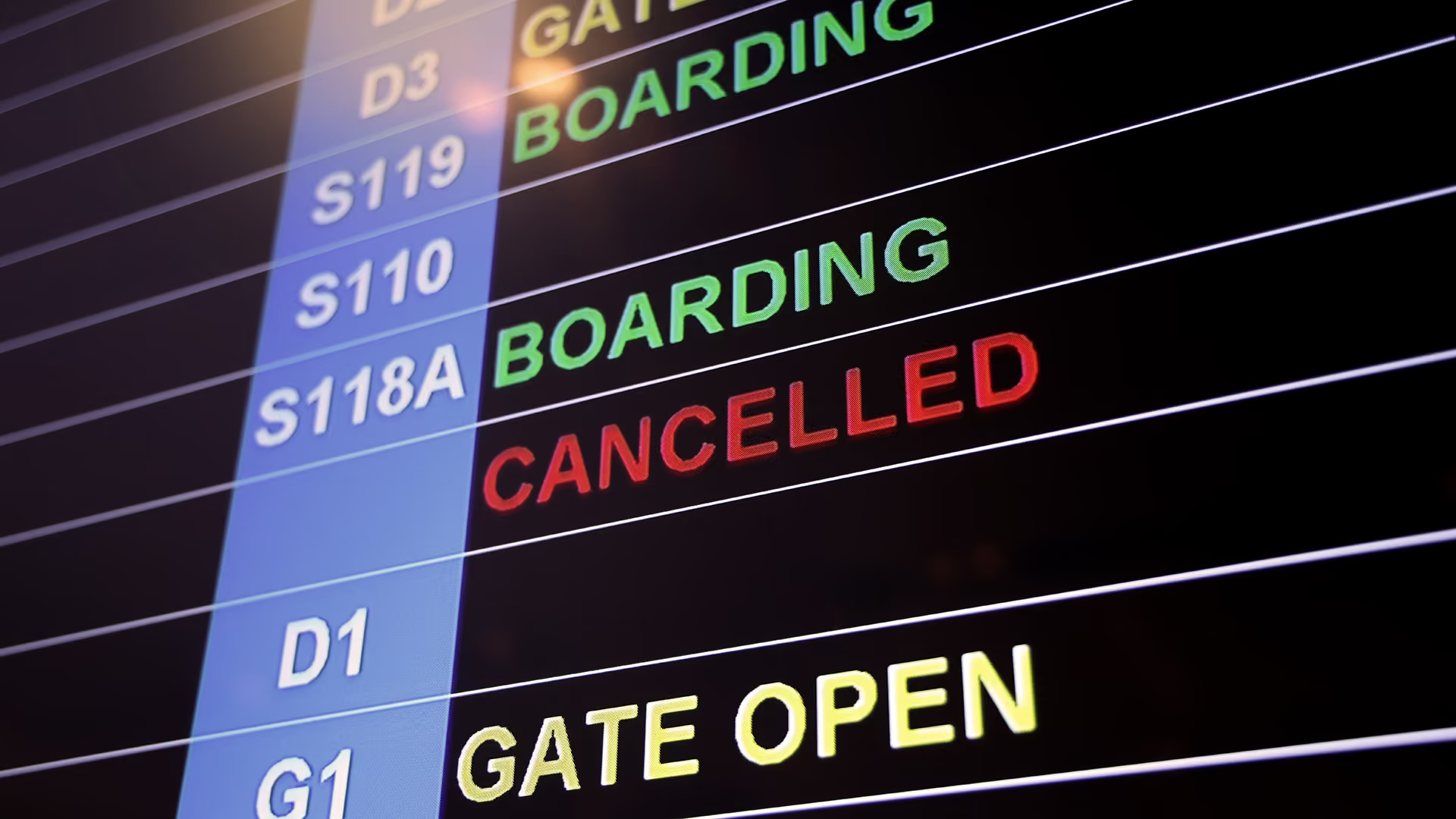
A core aspect of the PTRs is how changes and cancellations are managed. The regulations set clear boundaries on when prices and itineraries can be altered and what happens if a booking is cancelled. In this section, we break down the procedures for transferring packages, price changes, package characteristic changes and contract termination:
Travellers have the right to transfer their package to another person, provided the new traveller meets the necessary conditions for the holiday. The traveller must give the organiser at least seven days before the start of the package, and the original traveller and the new traveller have joint liability for the outstanding balance (and any fees associated with the transfer). However, the organiser must give the travellers evidence of these costs.
Organisers can only change package prices if they've outlined that they can do so in the travel contract for the following reasons:
In the same vein, the contract must allow for price reductions if the same factors lead to cost reductions for the organiser. The organiser can only change the price if they notify the traveller no less than 20 days before the start of the package, and they explain why the change is necessary.
Travellers can terminate the contract without a fee if price increases are over 8% of the original package price.
Organisers can't change the terms of the contract before the package starts (except for price, in line with the section above), except for insignificant changes communicated to the traveller.
If organisers have to:
The organiser must promptly inform the traveller and offer the option to terminate the contract without incurring a termination fee. This must be done in writing in a clear manner, and the traveller must be given a reasonable time frame to respond. If the traveller doesn't respond, the contract is terminated, and the organiser must refund all payments no later than 14 days after the contract ends.
Travellers can terminate contracts at any time before the package starts, but they may be required to pay a termination fee (taking expected cost savings and income from selling the travel services to another traveller into account, as well as third-party costs that don't need to be paid).
However, in some cases, organisers might not be able to give the travel service to another traveller, and a refund might not be justified.
Organisers can impose standardised termination fees in the contract, but they must provide clear justification for the termination fee if the traveller requests it. If the traveller terminates the contract, the organiser must refund the payment (minus any applicable termination fee) within 14 days.
‘Unavoidable and extraordinary circumstances’ are situations beyond the control of the party relying on them – they couldn't have been avoided even with all the reasonable measures in place.
While the Foreign, Commonwealth and Development Office (FCDO) office advice is used as a rule of thumb, organisers should also consider the traveller's specific circumstances.
Organisers can terminate contracts in some circumstances. When they do, they must give the traveller a full refund. This may happen when:

Building trust with your travellers is vital, and the PTRs ensure that trust is backed by robust financial guarantees. The rules around insolvency protection exist to protect your customers, no matter what happens to your company.
Regulation 19 explains that, as an organiser, you are legally required to secure insolvency protection that, in the event of insolvency, ensures all customer money is refunded and, where relevant, customers are repatriated. These arrangements must cover all reasonably foreseeable costs:
The insolvency protection put in place must:
Insolvency protection can also facilitate the continuation of the package rather than a refund, allowing the holiday to go ahead.
Some organisers take out supplier failure insurance (SFI) or scheduled airline failure insurance (SAFI) to cover the refunds to travellers in the event of supplier failure. However, this doesn't remove the organiser's obligation to arrange insolvency cover.
Organisers selling package holidays with flights must have insolvency protection through ATOL.
Regulation 20 and Regulation 21 outline that bonds must be issued by an approved body to ensure the bond meets insolvency requirements. Please note that bank guarantees don't comply with the regulations.
Approved bodies monitor trade activity and manage the bond to make sure travellers are refunded. Bonds have a maximum term of 18 months, and the required sum is calculated as follows:
Regulation 22 outlines that organisers can take out one or more insurance policies that pay travellers directly in the event of insolvency.
An example of this is financial failure insurance (FFI), an insurance-backed insolvency protection solution that can satisfy the Package Travel Regulations requirements for non-flight package organisers. Unlike supplier failure insurance or scheduled airline failure insurance, FFI is designed to protect customers if the organiser itself becomes insolvent.
Depending on the structure, FFI can provide:
For many travel businesses, financial failure insurance provides an attractive alternative to traditional trust account or bonding arrangements.
Whichever insurance you choose, please note that it must be held by a UK, Channel Islands, or Isle of Man authorised insurer, and organisers should ensure the policies are not voided due to negligence or a breach of conditions.
Insurance policies can be written so that an Approved Body administers claims for the insurer and manages repatriation arrangements for affected travellers.
Funds held in a trust account are ring-fenced. Regulation 23 outlines that the independent trustee is authorised to release these funds to the organiser only when they receive evidence that the package has been fulfilled or the traveller has been refunded. Funds may also be released if the traveller has cancelled the booking and funds have been forfeited as cancellation fees.
The organiser pays the trust's operating costs. This includes the cost of administering claims in the event of insolvency. But costs must be a drain on the trust, as travellers must be reimbursed in full.
If the package includes carriage of passengers, the organiser must be insured to repatriate travellers (and where necessary, provide accommodation) and pay the travellers directly in the event of insolvency.
Organisers may combine a trust account with insurance. Under this hybrid model, the trust is only required to hold funds for liabilities not already secured by insurance. Please note that this insurance is in addition to the insurance the organiser requires to cover repatriation costs. Any insurance policies must be with UK, Channel Islands or Isle of Man authorised insurers.
Some businesses may choose to combine bonding and insurance or trust structures with additional supplier failure insurance. Hybrid models can provide additional flexibility and may help businesses balance customer protection, regulatory compliance and operational requirements. The most appropriate insolvency protection structure will depend on the individual business.

The PTRs (specifically Regulation 5 and Regulation 6) place heavy emphasis on organisers being transparent with travellers, and providing them with the correct information about their trip is essential.
When a retailer sells a package, the retailer and the organiser must be sure that travellers receive the required information before and after the sale. When an organiser sells a package, they must provide the information to the traveller. In this section, we'll call the party responsible ‘the operator’.
Before selling the package, the operator must provide travellers with the following information:
This pre-contractual information, also known as Schedule 1, is binding and cannot be altered without the traveller's consent.
The information above must be provided, along with a standard information form outlining the protection package offered by travel holidays. However, the forms vary depending on how they’re sold.
For example, operators selling via a website that uses hyperlinks use Schedule 2 forms.
When hyperlinks aren't valuable, or the package is agreed over the phone, operators use Schedule 3 forms.
For packages formed through linked online booking processes, both traders must provide the relevant Schedule 1 information for their specific services, while the initiating trader must also provide the Schedule 4 form.
From 6th April 2027, bookings that are currently Type A LTAs become packages, so they will need full package information rather than the lighter LTA forms. Businesses relying on Type A structures should review their booking flows and customer documentation ahead of the change.
Once the sale is completed, Regulation 7 requires the operator to give the traveller a copy/confirmation of the contract. If the operator is selling face-to-face, they must provide a paper copy if asked. For sales made off-premises, the contract should be on paper or in a durable medium that the traveller agrees to.
The contract must include trip details (Schedule 1), with additional information listed in Schedule 5. This includes information on the company in charge of insolvency protection and its contact details.
For a linked online booking, the second trader must let the first trader know when the sale is complete, and share the necessary details to allow the first trader to complete the Schedule 5 requirements. Well before the trip starts, the operator must also provide the traveller with receipts, vouchers and tickets, as well as clear departure times, check-in and arrival information and transport connection details.
It's good practice to let travellers know of any permitted changes to the package promptly, as well as reminding them of key dates and deadlines.

One of the most significant changes introduced by the updated Package Travel Regulations is the reform of Linked Travel Arrangements (LTAs).
Historically, LTAs sat between standalone travel bookings and package holidays. They provided a limited level of consumer protection but did not create the same obligations as a package holiday.
The Government concluded that LTAs often caused confusion for both consumers and travel businesses and has therefore reformed the framework from April 2027. The most important distinction is that Type A LTAs and Type B LTAs will be treated very differently.
This is potentially the most significant consequence of the updated regulations.
A Type A Linked Travel Arrangement currently exists where a traveller purchases one travel service and then purchases another travel service in a separate transaction during the same visit to a trader's point of sale.
For example:
Historically, these arrangements have been classified as Type A LTAs.
From 6th April 2027, these arrangements will generally be classified as packages.
This means businesses facilitating these bookings may become package organisers and therefore acquire additional legal responsibilities including:
This change is likely to have a significant impact on online booking platforms, airline websites, OTAs and travel businesses that facilitate the purchase of multiple travel services during a single customer interaction.
Travel businesses should carefully review:
Businesses currently relying on Type A LTA structures may require Package Travel Regulations compliant insolvency protection from April 2027.
The second major reform concerns Type B LTAs.
A Type B LTA currently arises where a trader facilitates the purchase of an additional travel service from another trader in a targeted manner.
Examples may include:
Historically, these arrangements could create regulatory obligations under the LTA framework. From April 2027, Type B LTAs will cease to exist.
This means businesses will still be able to refer customers to relevant third-party suppliers without triggering Package Travel Regulations financial protection requirements for those referred services.
This change is expected to reduce compliance complexity for:
An interesting aspect of the reforms is that there is currently no proposal to amend the package definition within the ATOL Regulations.
This means there may be circumstances where the revised Package Travel Regulations and the existing ATOL framework do not align perfectly. Whether this is a temporary position or an indication that wider ATOL reform may follow remains to be seen.
Travel businesses selling flight-inclusive arrangements should therefore seek specialist advice when assessing the impact of the new rules.

If travel providers facilitate an LTA, they must be clear with travellers that they aren’t purchasing a package holiday. It’s important to explain that only the individual service providers are responsible for their specific parts of the trip. This information, along with details of insolvency protection, needs to be presented clearly.
There are several standard information forms to help operators meet the information requirements of the PTRs:
Please note: From 6th April 2027, these forms will no longer be necessary. Schedules 6, 7 and 8 (Type A) become redundant because those bookings become packages and require package information instead. Schedules 9 and 10 (Type B LTAs) are abolished entirely after this date, but please be aware that the forms still apply to LTAs entered into before the changes come into effect.

Understanding the consequences of PTR non-compliance is just as important as understanding the regulations themselves. This section outlines the penalties you face if obligations aren't met.
The Package Travel and Linked Travel Arrangements Regulations 2018 establish specific criminal offences for non-compliance. Traders may face criminal prosecution for the following breaches:
These regulations are enforced by the Civil Aviation Authority (CAA), local authority trading standard departments in Great Britain and the Department for the Economy in Northern Ireland.
There are no custodial penalties for those convicted of these criminal offences, only fines with no maximum limit on what can be imposed in England and Wales.
Outside of criminal prosecution, the rights and obligations within the 2018 PTRs are enforced primarily on a civil basis. Part 8 of the Enterprise Act 2002 also applies to these regulations – enforcers under the act can seek enforcement orders against traders who harm the collective interest of consumers.

Following its response to the ‘Package travel – updating the framework 2025’ consultation, the government published the Package Travel and Linked Travel Arrangements (Amendment) Regulations 2026 in April 2026. They come into effect on 6th April 2027 and apply only to arrangements entered into on or after that date. Here are the key changes:
The current LTA framework is viewed by many as too complex. The amendments streamline it by confirming the following:
A big win for travel organisers is the confirmed reform to Regulation 29. This establishes a 14-day period for the refund of cancelled services and clarifies that the regulations mean the “right to redress” vs. the “right to seek redress”. In practice, from 6th April 2027, suppliers must refund organisers within 14 days of a cancellation, or of the date the service was due to be performed, whichever comes first.
Regulation 30 is amended so that an organiser can't escape its obligations by declaring that it's acting only as an intermediary or travel service provider, or by declaring that a package is not a package. This anti-avoidance measure reinforces who carries the financial protection and performance responsibility for a package.
The amendment regulations were made in April 2026 and comes into effect on 6th April 2027. They are not retrospective: they apply only to contracts entered into on or after that date, so any booking taken before then continues to be governed by the existing rules. This gives the sector until April 2027 to review booking journeys, documentation and financial protection arrangements.

Aside from avoiding costly penalties, compliance with the Package Travel Regulations is about building trust with your customers. While you can read the PTRs in full on the UK government's dedicated legislation website, know that you don't have to navigate the regulations alone.
TMU Management offers solutions to help you meet your PTR obligations. We deliver intelligent embedded insurance solutions that protect and strengthen your travel business, embedding confidence across your entire value chain.
Get in touch today to discuss your travel business insurance needs.
Regulatory compliance starts with understanding the terms the regulations use. We’ve summarised the core terms used in this PTR guide to help you better understand your obligations:


If you need insurance that reflects how your business really works, TMU Management is here to help. Our team will assess your challenges, understand your exposures and design a bespoke solution that fits your strategy.
Contact usThank you for your interest in TMU Management. If you have any questions about our company or our services, please feel free to reach out via our contact form, or using the contact details below. We look forward to connecting with you soon!